How to set up a backyard badminton game in a small space
· Editorial team minneapolisnewsdaily24.com
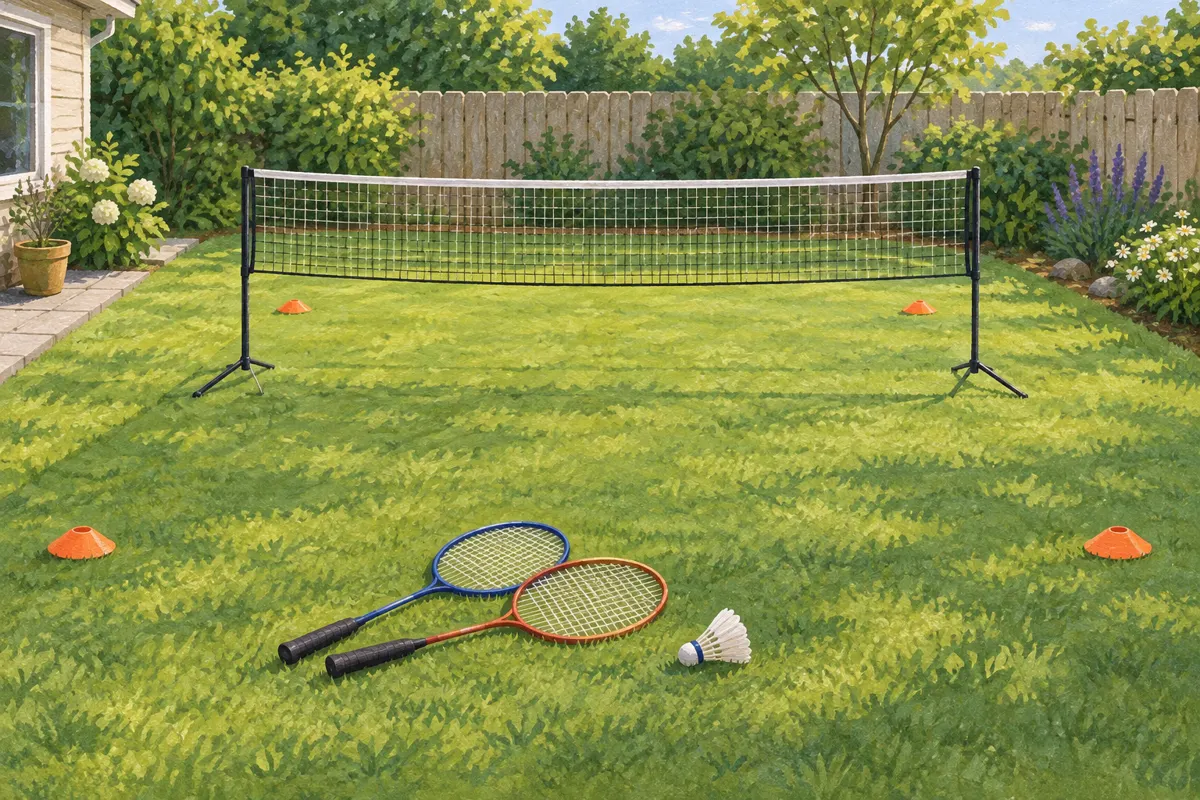
To play badminton in a small backyard, mark a clear rectangle, divide it into two equal halves and agree on simple house rules before serving. Fit the playing area to the usable space, leaving room to stop and swing safely. A racket for each player and a shuttlecock are the essentials; a net helps, but beginners can also practice without one.
Choose the clear space first
Start with the ground and the surrounding obstacles. Look for an area with secure footing, then check for slippery patches, holes, loose objects and overhead branches. Keep the playing boundaries away from fences, furniture, windows and planting beds. Space outside the lines matters because players need to slow down after reaching for a shot.
A standard court is 44 feet long and 20 feet wide for doubles, or 17 feet wide for singles. Those dimensions provide context, but a casual backyard game can use a smaller area under agreed house rules. The following compact setup is an editorial proposal; it does not reproduce a regulation court.
- Clear the area and choose the safest direction of play.
- Place temporary corner markers inside the usable space, with room beyond them for stopping.
- Walk through each half and gently rehearse a racket swing near the edges.
- Shrink or move the boundaries wherever a player could hit an obstacle.
Mark boundaries and set up the middle
For a proposed compact layout, make a rectangle with two equal halves. Use visible, low-profile markers that suit the surface, such as chalk on suitable paving or flat markers on grass. Avoid loose cords across places where players will step. Decide that a shuttle landing on a boundary counts as in, so close calls have a clear answer.
If you have a portable net, put it across the midpoint and follow its setup instructions. Keep supports and any guy lines outside the playing area. Without a net, our proposed alternative is to mark the midpoint at both sidelines and play gentle exchanges across that imaginary divider. Treat this as a simplified backyard activity.
Begin with one player on each side. Although badminton can be played with two or four people, singles gives each person more room in a confined yard. If four people want to join, our proposal is to rotate players between short games when doubles would leave too little swinging space.
Agree on a short set of house rules
The basic aim is to return the shuttle over the net before it touches the ground. A rally ends when a player cannot return it, sends it out or hits it into the net. Standard scoring awards a point for each rally won, with games normally played to 21. Shorter games are a practical house-rule proposal for backyard rotation.
- Play to 7 points, with the first player to reach 7 winning.
- Let the rally winner serve next.
- Start with a gentle underhand serve that the receiver is ready to return.
- Count boundary lines as in and replay disputed landings.
- Replay a rally interrupted by a person or pet entering the area.
- Stop the rally when a shuttle heads toward an obstacle; do not chase it beyond the safe space.
Make rallies work for different skill levels
A small court rewards controlled shots. Begin with gentle exchanges and aim toward the middle of the other half. A balanced stance with bent knees, short steps and a return toward the center after each shot can help beginners prepare for the next return.
- Start cooperatively and try to complete five consecutive returns together.
- Ask the more experienced player to avoid smashes and use easy-to-reach placements.
- Allow a beginner a second serve attempt while learning.
- Change only one rule at a time, then check whether rallies become easier to sustain.
Check conditions before each game
Wear shoes with good grip, tie shoelaces securely and warm up before starting. Keep early games gentle and increase the intensity gradually. Recheck the surface if conditions change, especially where grass or paving becomes slippery.
If the shuttle repeatedly drifts outside the area, our proposal is to switch to cooperative rallies or pause until conditions improve. Between games, retrieve stray shuttles and check that markers and net supports remain in place. Adjust the layout whenever players keep running out of room.