How to organize shoes and bags in a narrow entryway
· Editorial team minneapolisnewsdaily24.com
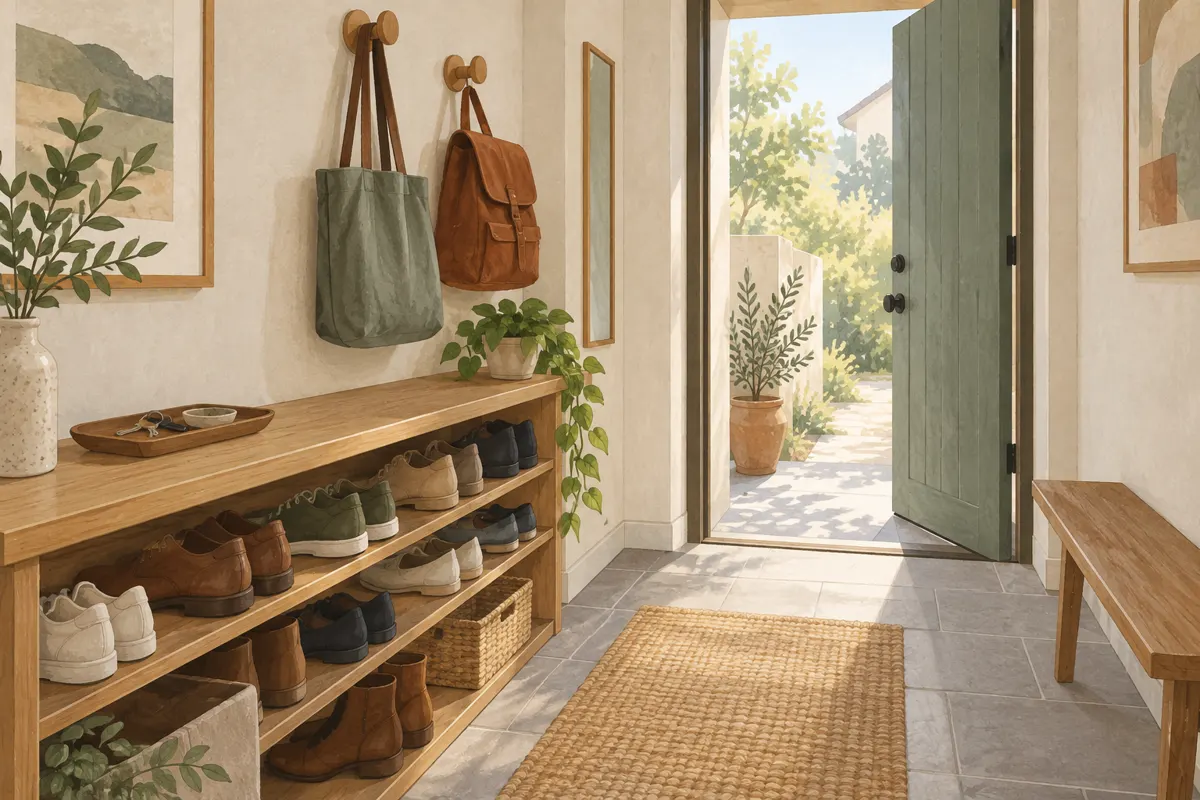
Keep a narrow entryway organized by putting everyday shoes along one wall, giving each bag a dedicated spot, and leaving the door swing and walking route clear. Start with measurements and the items you actually use. The proposed layout below combines a small shoe zone, wall storage for bags, and a quick daily reset.
Measure the doorway and walking route first
Empty the entryway before deciding where storage belongs. Open the front door fully and check nearby closet doors, too. The useful space is the area left after those doors can move freely and people can enter carrying their usual bags.
- Measure the hallway width at its narrowest point, including baseboards or other projections.
- Measure the usable wall length outside the door swing. Note outlets, vents, switches, and closet access.
- Measure your largest everyday shoes and your bag when it is packed. Include handles and straps.
- Mark a proposed storage footprint with removable tape. Walk past it carrying groceries or a backpack, then check the space needed to open drawers or tilt-out compartments.
Subtract the storage depth from the hallway width to see how much passage remains. Treat that calculation as a planning check, then try the taped layout in everyday use. A cabinet may fit against the wall while still leaving too little room to bend down or retrieve shoes comfortably.
Set a limit for shoes kept by the door
Entryway storage works best when it holds frequently worn shoes. Move occasional and out-of-season pairs to a closet shelf or suitable under-bed storage. Count the pairs that remain before choosing furniture, and check their actual dimensions rather than relying only on an advertised shoe capacity.
As a starting proposal, give each person space for one or two everyday pairs. Adjust that allowance to the available room and household routine. Assign a shelf, cubby, or section to each person so everyone knows where their shoes belong.
- Use a shallow cabinet where floor depth is limited; check both its closed depth and the clearance needed to open it.
- Choose an open rack when quick access and airflow matter most.
- Consider a bench with storage only if there is room to sit and stand without blocking the passage.
- Reserve a contained spot for wet footwear, and let shoes dry before putting them into closed storage.
If even a small rack crowds the doorway, place the main shoe storage in the nearest suitable closet or room. Keep only the pair being used at the entrance, within a defined spot outside the walking route.
Give bags reachable wall storage
Wall hooks can give everyday bags a home without adding another piece of floor furniture. Position them where users can reach them easily, with enough space between hooks for bags to hang without overlapping. A packed backpack projects farther into the hallway than an empty tote, so check the arrangement with bags loaded.
Our proposed arrangement is one assigned hook per everyday bag, with children's hooks at a reachable height. Keep straps off the floor and bags outside the door swing. Follow the hook manufacturer's load and installation instructions, including the fixing method for your wall.
For a bag that cannot hang conveniently, use a dedicated shelf or cubby nearby. Keep spare totes and occasional bags elsewhere. A small tray on an existing cabinet can hold keys, but leave enough clear surface to put them down without moving other objects.
Arrange storage along one side
For a tight entrance, the proposed layout is a single storage wall: shallow shoe storage below, bag hooks above or beside it, and a small key spot within reach. Start beyond the door swing. Check that hanging bags do not cover the shoe cabinet opening or make it awkward to reach the shelves.
Keep the opposite side clear wherever possible. Avoid adding a console, baskets, or decorative objects simply because there is a small gap. If you use an entry mat, check that the door clears it and that it stays in place; an appropriate anti-slip underlay can help prevent sliding.
Use a short daily reset
A proposed arrival routine is to put keys in their tray, hang the bag, and place shoes in the assigned section. Give temporary items, such as a return parcel, a destination elsewhere so the entryway does not become their permanent holding area.
- Each evening, return loose shoes and bags to their places and clear the walking route.
- Once a week, move unused pairs back to longer-term storage and empty the key tray of unrelated items.
- When seasons change, swap the shoes at the door instead of adding another layer.
- If the same item keeps landing on the floor, adjust its storage spot so it is easier to use.